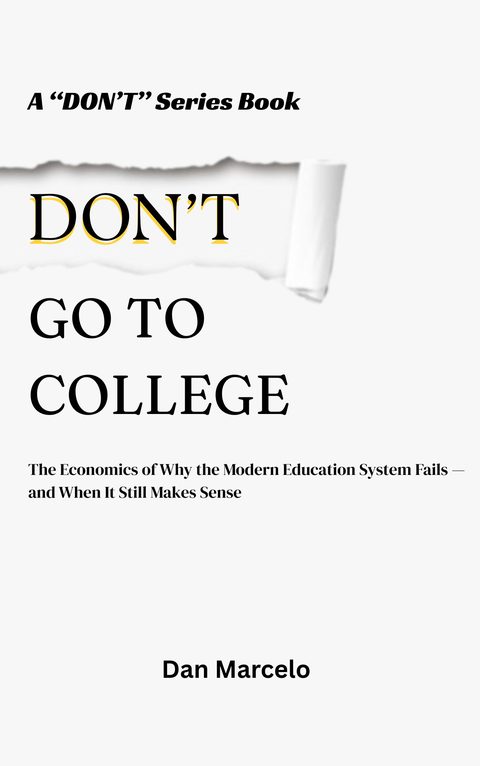
Don't Go to College
The Economics of Why the Modern Education System Fails—and When It Still Makes Sense
Is college still worth the cost?
A disciplined economic audit of higher education
For decades, college has been treated as a guaranteed path to success. Families borrow. Students enroll. Universities expand. Few are encouraged to ask the most basic economic question:
Is college still worth the cost?
In Don’t Go to College, economist and professor Danilo F. Marcelo Jr. examines higher education not as a cultural ideal, but as an economic system—one defined by rising prices, uneven outcomes, and misplaced risk.
This is not an attack on learning or ambition. It is a disciplined economic audit of a system that increasingly asks young people to make high-cost, debt-financed decisions under uncertainty—then blames them when outcomes fall short.
Using core principles from economics—investment analysis, opportunity cost, risk allocation, signaling theory, and labor-market dynamics—this book explains:
- Why tuition keeps rising even when graduate outcomes stagnate
- How opportunity cost functions as “invisible tuition”
- Why students absorb nearly all downside risk when degrees fail
- How credential inflation weakens the value of degrees
- Why averages like the “college wage premium” mislead individuals
- When college is economically rational—and when it clearly is not
- Why skills-first education, apprenticeships, and employer-led training often outperform traditional degrees
Unlike polemical critiques, Don’t Go to College is deliberately non-absolutist. Degrees required by regulation—such as medicine, law, engineering, and other licensed professions—are treated differently. The failure examined here is not individual. It is structural.
Written for parents, students, educators, employers, and policymakers, this book does not tell you what to do. It gives you the framework to decide—clearly, honestly, and without blind faith.
Education matters.
But so does asking who pays when it doesn’t work.
Preface
For generations, college education has been presented as an unquestionable good—an automatic gateway to opportunity, stability, and upward mobility. Families save for it, students borrow heavily for it, and governments subsidize it, often without asking the most basic economic question: Is this investment still worth its cost?
This book exists because that question is no longer being answered honestly.
I write this not as an outsider attacking education, but as an economist who has spent years inside the system—teaching, designing curricula, advising students, and observing outcomes. I believe deeply in education. I do not believe, however, that belief should replace analysis. In any other domain involving high costs, long-term commitments, and uncertain returns, we would demand rigorous evaluation. Higher education should not be exempt from that standard.
The modern college system is often defended with narratives rather than numbers. We are told that “any degree is better than none,” that college “always pays off in the long run,” and that rising tuition is justified by intangible benefits. These claims are repeated so frequently that they have become accepted truths—despite mounting evidence that, for a growing share of students, they no longer hold.
This book does not argue that education is unnecessary. It argues something more precise and more uncomfortable: the current structure, pricing, and incentive system of modern higher education fails basic economic tests for most degrees and most students.
Tuition has risen faster than wages for decades. Student debt has become a defining feature of early adulthood. Degrees increasingly function as screening devices rather than indicators of skill or productivity. Meanwhile, institutions face little consequence when graduates struggle, underemploy, or fail to recoup their investment. These are not moral failures; they are economic ones. They are the predictable outcomes of misaligned incentives, information asymmetry, and risk being borne by those least able to absorb it.
Importantly, this is not an absolute argument. Some professions—medicine, law, engineering, architecture, and other regulated fields—require formal degrees by design. In these cases, college functions as a regulatory toll rather than an investment choice. The economic calculus is different, and this book explicitly acknowledges those exceptions. To pretend otherwise would be intellectually dishonest.
Nor does this book claim that all colleges are equal. Elite institutions with strong networks and signaling power may still deliver positive returns for a narrow subset of students. The problem is not that college never works. The problem is that it is sold as though it always works.
That distinction matters.
What follows is an economic analysis of higher education as it exists today—not as it is imagined, and not as it once functioned. We will examine college using familiar tools: cost–benefit analysis, opportunity cost, risk allocation, signaling theory, and market failure. We will look at who benefits, who bears the risk, and why the system persists despite declining value for many participants.
This book is written for parents making financial decisions, for students facing debt before they have income, for policymakers concerned with productivity and mobility, and for employers frustrated by credential inflation. It is also written for educators willing to confront uncomfortable truths about the system they serve.
The goal is not to discourage learning, curiosity, or intellectual growth. The goal is to restore rational decision-making to an arena where emotion, tradition, and ideology have crowded out economics. Education should expand opportunity—not mortgage it. It should build human capital—not suppress it under debt and delay.
If college education still makes sense for you, this book will help clarify why. If it does not, this book will help you understand the alternatives—and why choosing them is not failure, but rationality.
Education remains essential. Blind faith in the current college system is not.
 Don't Be Trapped by Credit Cards
 Don't Save Money
 Don't Chase Passion
 Don't Follow Your Degree
 Don't Go to Work
 Don't Trust Job Security
 Don't Rely on a Single Income
 Don't Buy the House Yet
 Don't Start a Business Too Early
 Don't Design Life Around Work
 Don't Live Paycheck to Paycheck
 Don't Rely on Pensions