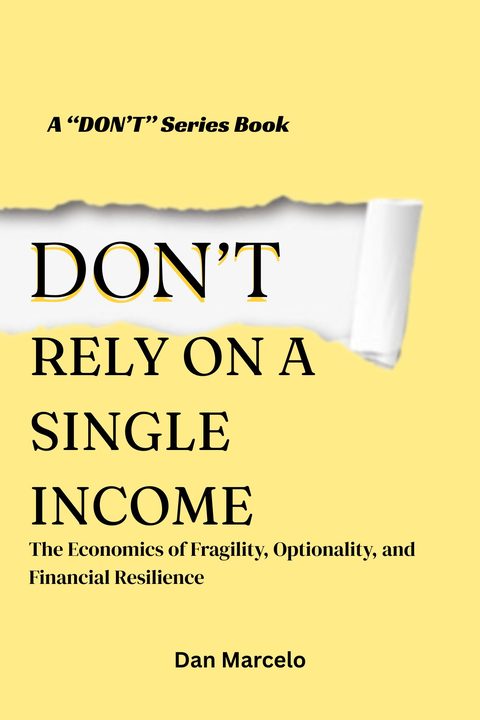
Don't Rely on a Single Income
The Economics of Fragility, Optionality, and Financial Resilience
A single income works—until the day it doesn’t.
This book is not about getting rich. It is about not collapsing.
When that happens, the damage is rarely gradual. It is immediate, clustered, and unforgiving.
Job loss does not arrive alone.
It arrives with inflation, debt, fixed costs, and limited options.
This book is not about getting rich.
It is about not collapsing.
Don’t Rely on a Single Income explains why modern households are more financially fragile than ever—despite higher education, better jobs, and careful planning. It shows why job security, savings, and insurance are no longer enough, and why most people mistake familiarity for safety.
Using clear economic reasoning—not hype—this book reveals:
- Why one income is a single point of failure
- How risk concentrates silently over time
- Why “stability” disappears precisely when you need it most
- What real financial resilience actually looks like now
This book does not tell you what to chase.
It tells you what not to rely on.
Read it before your income tests you.
Preface
Why One Income Is No Longer Safety
For decades, a single income was sold as stability.
One good job.
One reliable paycheck.
One employer you could depend on.
If you showed up, worked hard, and stayed loyal, income would follow. Security, we were told, was earned through consistency.
That story no longer holds.
Not because people became irresponsible—but because the economic structure underneath that promise changed.
Modern households now face risks that earlier generations did not:
- Faster technological displacement
- Shorter job lifecycles
- Higher fixed living costs
- Greater exposure to health, policy, and market shocks
Yet many people still anchor their entire financial lives to one income stream—often without realizing the risk they are carrying.
This book is not about hustling.
It is not about working more.
It is not about becoming an entrepreneur.
It is about fragility.
In economics, fragility describes a system that appears stable—until it is stressed. A single-income household may function smoothly for years, even decades, and then fail abruptly when one variable changes: a layoff, an illness, an industry downturn, or a policy shift.
What feels like safety is often concentration risk in disguise.
Economists understand this intuitively. No rational investor places all capital into one asset. No institution depends on a single revenue source. Diversification is not ambition—it is survival logic.
Yet at the household level, many people do exactly that with income.
They call it responsibility.
They call it focus.
They call it stability.
This book challenges that assumption.
You will learn to view income the way economists view portfolios:
- Income streams as assets
- Jobs as high-correlation exposures
- Optionality as real security
The goal is not abundance.
The goal is resilience.
By the end of this book, you will no longer ask, “How stable is my job?”
You will ask a more important question:
“How fragile is my income structure?”
That shift—quiet, structural, and rational—is where real financial security begins.
 Don't Be Trapped by Credit Cards
 Don't Save Money
 Don't Chase Passion
 Don't Follow Your Degree
 Don't Go to Work
 Don't Trust Job Security
 Don't Buy the House Yet
 Don't Start a Business Too Early
 Don't Go to College
 Don't Design Life Around Work
 Don't Live Paycheck to Paycheck
 Don't Rely on Pensions