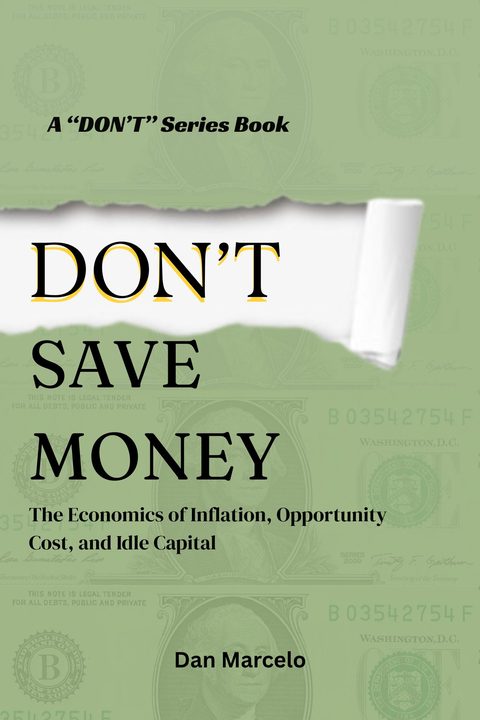
Don't Save Money
The Economics of Inflation, Opportunity Cost, and Idle Capital
Most people think saving money is responsible. Economics disagrees.
Why “playing it safe” often produces the most predictable losses
Don’t Save Money dismantles one of the most trusted beliefs in personal finance: that saving is always safe, disciplined, and smart.
It isn’t.
Saving without understanding inflation, opportunity cost, and idle capital quietly destroys purchasing power while giving the illusion of progress. Money that does nothing is not neutral—it decays.
This book does not offer investment tips, get-rich promises, or financial hacks. Instead, it exposes the hidden costs of waiting, the silent tax of inflation, and why “playing it safe” often produces the most predictable losses.
Written for readers who feel financially disciplined yet stuck, Don’t Save Money reframes personal finance through economic logic rather than moral rules.
If you believe saving is always the right move, this book will make you uncomfortable.
That is the point.
Preface
Why This Book Had to Be Written
Saving money is one of the most socially praised behaviors in modern life. Parents teach it. Schools reward it. Governments encourage it. Financial institutions profit from it. Entire moral frameworks are built around the idea that saving is virtuous and spending is reckless.
This book exists because that belief is economically incomplete—and often harmful.
Saving money is not a neutral act. It is not passive. It is not safe by default. Every peso, dollar, or euro left idle is making a decision whether its owner realizes it or not. That decision has consequences. Some are visible. Most are not.
Inflation does not announce itself loudly. It erodes quietly. Opportunity cost does not demand attention. It compounds silently. Idle capital does not look dangerous. It simply decays while pretending to be disciplined.
This book does not argue that saving is useless. It argues something more uncomfortable: saving without understanding economics is indistinguishable from slow financial surrender.
You are not poor because you failed to save enough.
You are stuck because you were taught to stop thinking once the money was set aside.
This is not a book about stock tips, hustle culture, or financial shortcuts. It offers no promises of wealth and no guarantees of security. What it offers instead is clarity—about what money actually does, what time does to money, and why doing nothing is rarely harmless.
If earlier books in this series questioned institutions—college, work, jobs—this book questions behavior. Specifically, the behavior that feels the safest and costs the most.
Money that does nothing is not neutral. It decays.
Buy on AmazonKeep reading
 Don't Be Trapped by Credit Cards
 Don't Chase Passion
 Don't Follow Your Degree
 Don't Go to Work
 Don't Trust Job Security
 Don't Rely on a Single Income
 Don't Buy the House Yet
 Don't Start a Business Too Early
 Don't Go to College
 Don't Design Life Around Work
 Don't Live Paycheck to Paycheck
 Don't Rely on Pensions